ANowX AIPipe Officially Launches: From PRD to Runnable Application with a Single Upload
Published on November 23, 2026 by ANowX Team

What It Is
ANowX AIPipe is an AI software factory installed on the enterprise's own desktop. After a user submits requirements, the platform assesses the task, matches a development team, and has different roles within that team collaborate on analysis, coding, testing, and review, ultimately delivering a runnable application ready for acceptance.
Its differences from common AI coding tools lie in three areas:
- Delivery unit: Not a snippet of code or a function, but a complete runnable application.
- Responsibility model: Not a single assistant, but coordinated division of labor among multiple roles within a team.
- Execution location: Runs locally on the desktop; project materials, conversation history, and execution records are stored on the local machine.
How a Task Begins
AIPipe offers three entry points, depending on how far the requirements have been developed:
- Upload PRD: Requirements are already documented; supports docx, pdf, and md formats.
- Natural language conversation: Requirements are still under discussion; users can clarify through dialogue before confirmation.
- Summon a team: When a specific capability is already clear, users can directly invoke the corresponding team from the plugin marketplace.
What the Platform Does After the PRD Arrives
After the document is uploaded, the parser extracts functional modules, APIs, data models, and acceptance criteria. A difficulty assessment mechanism combines module scale, dependencies, domain expertise, and delivery standards to produce a complexity rating, then matches a development team accordingly. Users can also manually override the platform's selection.
Suitable and Unsuitable Use Cases
The current version is better suited for:
- Tasks with clear requirement boundaries and verifiable acceptance criteria.
- Internal management tools, business reports, approval workflows, product prototypes, and small-to-medium application MVPs.
- Small-to-medium internal projects where business stakeholders can participate in acceptance.
It is not recommended for: research-oriented projects still in exploration without clear requirements; high-frequency trading systems with extreme real-time demands; and embedded development requiring direct hardware interaction.
Data Storage and Traceability
The desktop client stores project source code, attachments, conversation history, and execution records on the local machine. When the platform calls a model, the request content required for the current task is sent to the selected model service; the specific scope depends on the model and deployment configuration.
For process traceability, the available mechanisms include: tool permission requests and decisions written to local records; execution events appended in sequence with monotonically increasing sequence numbers; audit records using chained hashing to detect tampering; and a deny list restricting high-risk operations such as force push, hard reset, and modification of existing commits.
Related Articles
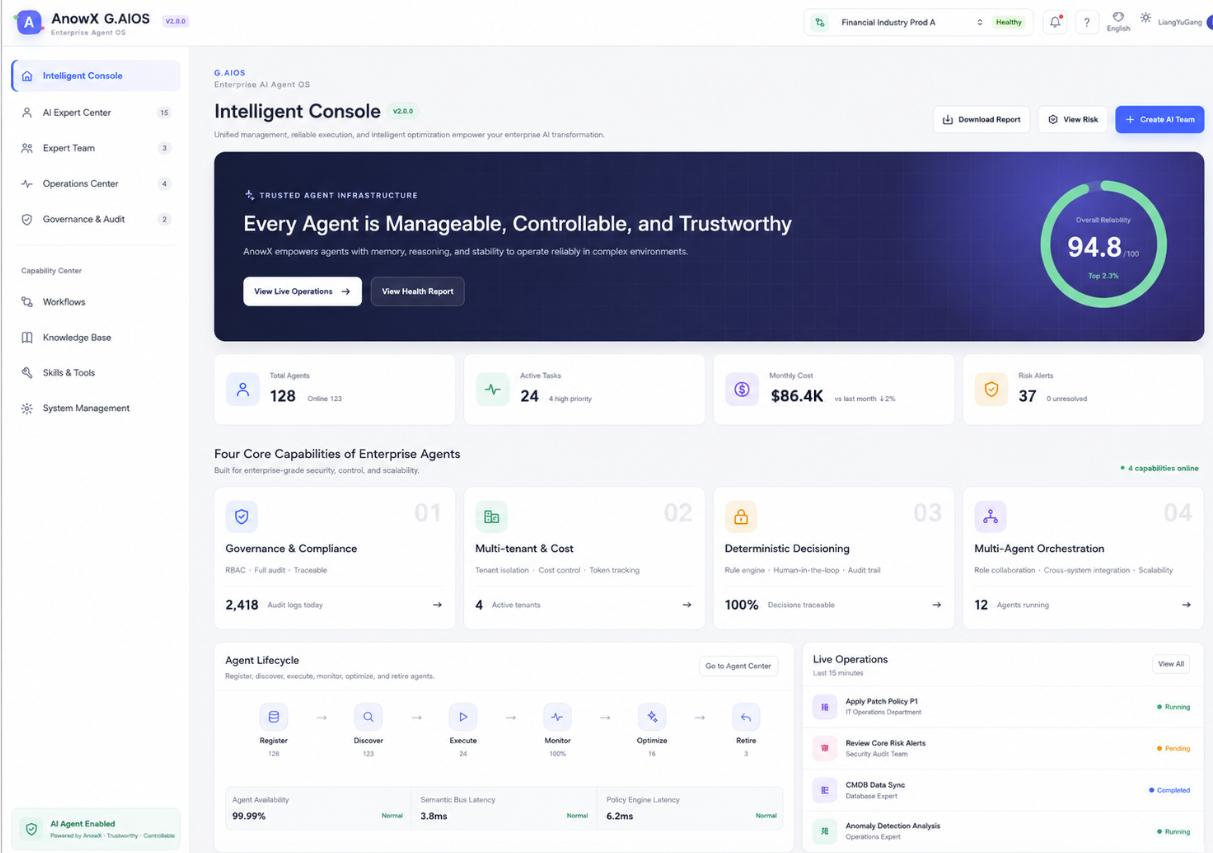
What Enterprises Truly Lack Is Not More Agents, but an Operating System That Can Take Responsibility for Agents
Enterprise AI doesn't need more Agents — it needs an Agent Operating System (AIOS) that embeds governance, multi-tenant isolation, deterministic execution, and multi-Agent collaboration.

Peak Season Resilience for Digital Supply Chains
How AI-powered service management keeps digital supply chains running when demand spikes.

AI-Powered BCM: Enhancing Risk Management
How artificial intelligence is transforming business continuity management and risk assessment processes.
Ready to unify your IT operations?
See how ANowX.AI can transform your service management, compliance, and vendor governance.
Contact us directly: contact@anowx.com | +65 81213475