What Enterprises Truly Lack Is Not More Agents, but an Operating System That Can Take Responsibility for Agents
Published on August 21, 2026 by ANowX Team
01 When AI Begins to Act, Enterprises Face More Than Just Accuracy
In personal scenarios, an inaccurate response may be merely an experience issue. But in financial institutions and large enterprises, a single unauthorized system call, one erroneous change operation, or one cross-tenant data access can escalate into operational risk, compliance risk, business disruption, and reputational damage.
Therefore, there is a real “production chasm” between enterprise-grade Agents and consumer-grade AI. This chasm cannot be crossed by simply adding more plugins or building another Agent store. It consists of at least four structural gaps.
Gap 1: No enterprise-grade governance.
Agents lack independent digital identities; their permissions are tied to developers or shared accounts. RBAC, least privilege, approval, auditing, data classification, and compliance policies are not embedded into every action.
Gap 2: No multi-tenant isolation or cost control.
There are no strict boundaries between different institutions, branches, departments, projects, and clients. Model, token, tool, compute, and external API costs cannot be measured, budgeted, allocated, or alerted upon.
Gap 3: No deterministic execution boundaries.
Models can offer suggestions but cannot guarantee that every step follows fixed policies, uses validated data, preserves evidence, passes necessary approvals, or recovers from checkpoints or rollback upon failure.
Gap 4: No true multi-Agent collaboration.
Many projects still stagnate at side-by-side Agent displays, lacking role routing, task disaggregation, semantic communication, state persistence, conflict arbitration, and result aggregation—making them incapable of handling long-chain, complex tasks.
The most dangerous state for enterprise AI is not “AI is not yet smart enough,” but “AI has already begun to act, while the enterprise has not yet established the systems and controls to take responsibility for it.”
Enterprise technology projects often fail not because of a “lack of capability,” but because capabilities are not placed within clear processes, permissions, data, approvals, monitoring, and accountability systems. The same applies to Agents.
An Agent that can call monitoring, logs, CMDB, deployment platforms, databases, OA, ERP, or core business interfaces is no longer a prompt—it is a “digital employee” with data rights, tool rights, and action rights. Enterprises cannot merely train it to do tasks; they must also complete its on-boarding, authorization, division of labor, assessment, supervision, review, and off-boarding.
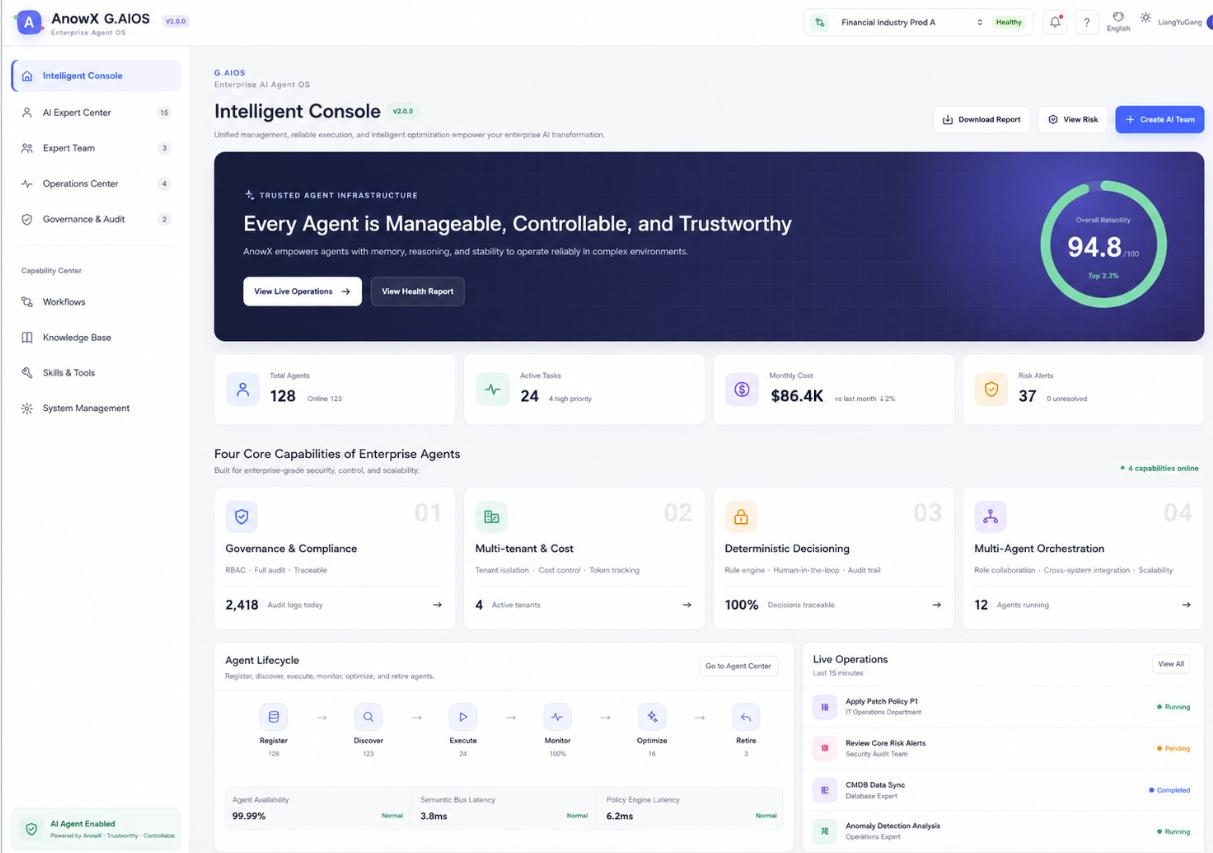
The AIOS sits between large language models, Agent frameworks, and enterprise business systems. Upward, it provides business users with AI experts, expert teams, and goal-driven task entry points. Downward, it connects models, knowledge, Skills, MCP, APIs, and legacy systems. In between, it uses runtime, orchestration, memory, policy, and governance capabilities to ensure every action occurs within controllable boundaries.
From an architectural perspective, the AIOS is not a single page or a single tool, but three interlocking parts:
- The business use surface handles “who to find and what results to deliver.”
- The Agent runtime handles “how to decompose, collaborate, execute, and recover.”
- The governance control plane handles “who can do what, to what extent, at what cost, and how to prove it.”
The global Agent market is maturing rapidly.
- Microsoft Agent 365 emphasizes an identity-first Agent control plane.
- ServiceNow AI Control Tower emphasizes discovery, governance, observability, and value measurement of AI assets across the enterprise.
- AWS Bedrock AgentCore emphasizes secure runtime, identity, memory, and observability.
- Google Gemini Enterprise Agent Platform emphasizes building, scaling, governance, and optimization.
- IBM watsonx Orchestrate emphasizes open catalogs, multi-Agent orchestration, and control planes.
- Salesforce Agentforce focuses on CRM, Data Cloud, and business processes.
Each of these products has clear strengths. The differentiation of Ziling (AIOS) is not simply claiming “others don’t have it,” but rather choosing a combination that is more aligned with the production control needs of Chinese financial institutions and large enterprises:
- Using Agent OS as the boundary to uniformly manage Agents across models, frameworks, and systems;
- Embedding financial-grade governance, deterministic execution, multi-Agent collaboration, four-layer memory, full lifecycle management, multi-tenancy, and cost control into the same task execution chain.
In other words, the AIOS is neither a general-purpose AI entry point for employees, nor a purely developer-focused Agent-building tool. It is more like the “control plane + runtime + collaboration network + evolution system” for an enterprise’s digital workforce.
Traditional Agent platforms are accustomed to displaying models, IDs, versions, knowledge bases, and tool counts. Technically, this is not wrong, but for chairpersons, business heads, and frontline employees, such information cannot answer the most critical questions:
What can it accomplish for me? Is it reliable? Who is responsible for the results?
The AIOS V0.2.0 refactors the “Agent list” into an “AI Expert Center.” Users do not first select a model; instead, they describe a business goal. The system then recommends suitable AI experts or expert teams based on task characteristics, data scope, professional capabilities, current load, risk level, and authorization boundaries. Each expert is more than a chat dialog—it should have a complete “job profile”: professional role, capability map, applicable boundaries, knowledge sources, Skills and tools, data permissions, risk level, human approval points, SLA, task history, costs, and evaluation results. What enterprises see is not “a prompt” but a digitally registered, certified, authorized, and continuously assessed digital expert.
Complex enterprise tasks are almost never a single-capability issue. For example, a P1 major incident response may simultaneously require alarm noise reduction, log analysis, topology localization, change correlation, database diagnostics, business impact assessment, communication escalation, and post-mortem improvement. Stuffing all these capabilities into one “universal Agent” is neither professional nor controllable.
02 A Specialized Division-of-Labor Expert-Team Model
Our AIOS adopts a specialized division-of-labor expert-team model:
- Planner Agent handles goal decomposition and role routing.
- Specialist Agents handle evidence collection, analysis, and action respectively.
- Conflict Arbiter verifies sources, logic, and policies, and resolves disagreements among Agents.
- Aggregator consolidates results into a unified output.
The entire process exchanges context, evidence, and state through a semantic message bus, rather than relying on uncontrolled free-form dialogue.
- Intelligent role routing: dynamically matches the most suitable Agent based on goal, domain, data, permissions, risk, and load.
- Closed-loop task disaggregation: breaks complex goals into executable units, clarifying dependencies, completion conditions, and delivery formats, then reintegrates them.
- Intelligent conflict arbitration: when different Agents reach inconsistent conclusions, prioritizes verification of data timeliness, source credibility, evidence completeness, and policy constraints—rather than simple “majority rule.”
- State persistence: fully preserves task context, execution state, and checkpoints, allowing resumption after system anomalies without restarting long-running tasks.
03 From Probabilistic Models to Verifiable Evidence
Large language models are inherently probabilistic. Enterprises should not promise “AI never makes mistakes.” The truly professional approach is to use engineering and governance measures to define where AI can act autonomously, where it must verify, and where it must wait for human approval.
In a financial regulatory policy variance analysis, for example:
- The Planner first freezes the task objective and output standards.
- The Policy Engine checks data access and tool permissions.
- Specialist Agents read authorized materials and produce source-attributed analyses.
- The Conflict Arbiter performs evidence verification on conflicting conclusions.
- The Aggregator produces a consolidated report.
- High-risk tool calls enter human approval; the system generates checkpoints for critical steps and continuously records resources, costs, and audit events.
A crucial point: what enterprise auditing truly needs is not exposure of the model’s private “chain-of-thought,” but a verifiable business evidence chain: what data were used, what tools were invoked, which policies were triggered, who approved what, what changed before and after execution, and whether results met acceptance criteria. Our AIOS consolidates this information into replayable execution trails.
04 Runtime Governance Embedded in Every Action
Many AI platforms treat governance as model registration, policy documentation, or pre-go-live reviews. But Agent risk occurs at runtime: it may read sensitive fields, call high-risk tools, cross tenant boundaries, or continue executing after budgets are exhausted. Therefore, governance must be embedded in every identity authentication, data access, tool invocation, policy judgment, and result delivery.
- Unified identity and RBAC: establishes a unique digital identity for each Agent, granting least-privilege permissions based on users, roles, positions, scenarios, and resources, avoiding shared accounts and permission drift.
- Runtime sandbox isolation: restricts file, network, process, tool, and external system access to mitigate malicious code, prompt injection, and data exfiltration risks.
- Full-chain behavioral auditing: records identity, context, data, tools, policies, approvals, results, and costs, supporting retrieval, replay, anomaly alerts, and audit forensics.
- End-to-end encryption, intelligent masking, and human-in-the-loop: controls plaintext scope according to data classification, accommodates national cryptography standards, private deployment, and customer key systems; mandates human confirmation for fund transfers, production changes, sensitive data, and high-risk tools—achieving “low-risk automation, high-risk approval.”
05 Four-Layer Memory with Governance Boundaries
An Agent without memory is like a new hire starting from scratch every time. Memory without governance may become a long-term data risk. Our AIOS divides memory into four layers, each with different storage periods, access rights, write rules, and security boundaries.
- Working memory – instantaneous compute power: carries current task context, temporary variables, tool results, and intermediate states for real-time coherence; releases or summarizes upon task completion according to policy.
- Episodic memory – historical accumulation: retains authorized user preferences, interaction traces, environmental changes, and task experiences across sessions, enabling continuous service capability.
- Procedural memory – skill acquisition: consolidates validated expertise, standard processes, solution paths, and tool usage patterns, allowing best practices to be reused.
- Reflective memory – evolution core: reviews failures, deviations, human takeovers, and low-scoring results to form improvement strategies; after evaluation, approval, and version control, these are written into procedural or long-term memory.
More importantly, our AIOS does not advocate “permanently storing all conversations.” Every memory entry should carry tenant, source, sensitivity level, trustworthiness, purpose, retention period, and deletion rules. Cross-tenant visibility is prohibited; sensitive memories cannot be called by low-permission Agents; unverified reflections cannot directly enter production skills. Continuous evolution must occur within governance boundaries.
06 Full Lifecycle and Cost Control
After enterprises scale their use of Agents, “Agent sprawl” inevitably emerges: duplicate builds, unmaintained instances, departing owners, expired permissions, outdated knowledge, model version drift, and runaway invocation costs. Our AIOS uses a unified registry center to manage the complete lifecycle—from registration, discovery, authorization, evaluation, release, runtime, monitoring, evolution, rollback, to retirement.
Each Agent has an owner, version, capability profile, dependencies, risk level, SLA, cost center, and health status. The system can elastically schedule compute resources based on load, apply circuit breakers or downgrades to anomalous Agents, and prompt retirement for Agents that are long unused or lack an accountable owner.
On the cost side, our AIOS aggregates model token usage, inference compute, knowledge retrieval, tool invocations, external API calls, and human approval costs down to tenants, departments, scenarios, expert teams, and individual tasks. It supports budgets, quotas, alerts, Showback, and Chargeback. Cost thus ceases to be just a monthly bill—it becomes a real-time constraint for every task routing and model selection decision.
07 Where the AIOS Focuses: Five Scenarios
The AIOS does not compete on the generalized narrative of “being able to do everything.” Instead, it prioritizes scenarios that demand the highest levels of professional methodology, system integration, process closure, and governance evidence. Ziling’s long-standing experience in IT management, technology governance, and production operations enables the platform to understand the real dependencies among incidents, problems, changes, configurations, releases, risks, controls, and continuity.
Scenario 1: Major Incidents and Intelligent Operations
When a P1 incident occurs involving payments, trading, core databases, or production networks, the expert team can automatically aggregate alerts, logs, traces, topology, CMDB, and recent changes to complete impact assessment, root-cause candidates, remediation recommendations, automated actions, and communication escalation. High-risk operations enter human approval; after recovery, a timeline, evidence package, and post-mortem improvement are automatically generated.
Scenario 2: Change Releases and Software Factory
Across the requirements, development, testing, release, and operations pipeline, the AIOS can orchestrate collaborative work among requirement analysis, code review, security scanning, test generation, change risk assessment, and release validation Agents. It embeds policy gates, human approvals, canary strategies, checkpoints, and rollback plans into the software delivery process.
Scenario 3: Regulatory Compliance and Technology Risk
In response to new regulations, internal control requirements, and audit inspections, a compliance expert team can perform gap analysis of policies, clause mapping, control effectiveness checks, evidence collection, and rectification tracking. Every conclusion carries source attribution, version, responsible person, and audit trail—avoiding the scenario where “AI generates a report that looks correct but is unverifiable.”
Scenario 4: Business Continuity and Operational Resilience
The AIOS can integrate with BCM, ITSM, monitoring, emergency communications, and drill platforms to continuously verify critical business services, dependent resources, recovery objectives, and response plans. During disruptions, it orchestrates situational assessment, resource scheduling, decision escalation, and recovery tracking.
Scenario 5: Enterprise Shared Services and Professional Operations
In areas such as finance, procurement, HR, legal, customer service, and knowledge research, the AIOS provides role-based capabilities through the expert center, connects to legacy systems via workflows, and controls data and action permissions through its governance layer. Enterprises can start with low-risk assisted scenarios and gradually expand to autonomous execution.
Conclusion
Don’t start by “building 100 Agents.” Start by “running one trusted closed loop.”
AnowX-AIOS helps you select one high-value scenario, first establish the control plane (identity, permissions, auditing, budgeting, rollback), and then replicate the proven approach. Once this mechanism is operational, you gain not just one Agent, but a production mechanism that can sustainably replicate digital roles, professional capabilities, and governance rules.
Proceed with caution—but move faster.
Related Articles
Peak Season Resilience for Digital Supply Chains
How AI-powered service management keeps digital supply chains running when demand spikes.

AI-Powered BCM: Enhancing Risk Management
How artificial intelligence is transforming business continuity management and risk assessment processes.

Insurance: Compliance and Operational Resilience
How insurers can strengthen compliance and operational resilience with integrated AI.
Ready to unify your IT operations?
See how ANowX.AI can transform your service management, compliance, and vendor governance.
Contact us directly: contact@anowx.com | +65 81213475